
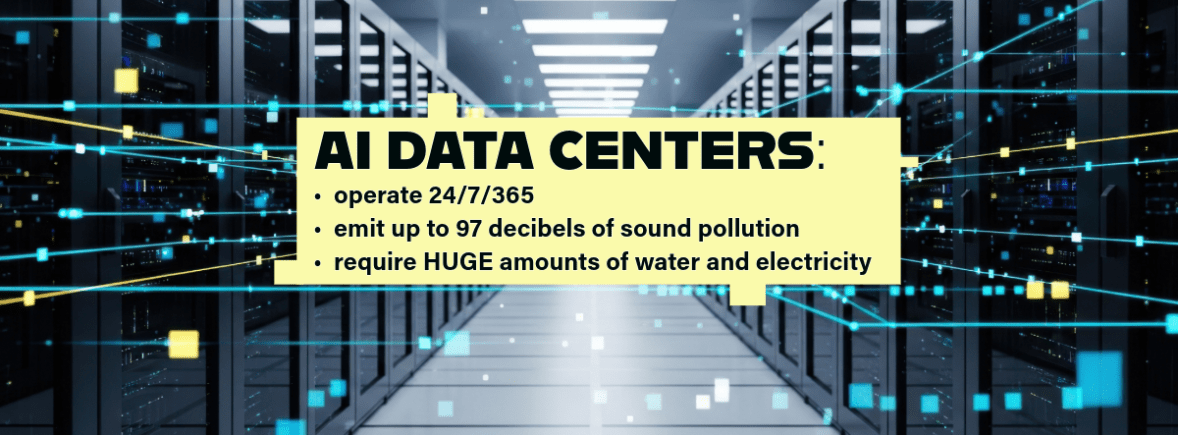
Data centers are a big issue across the United States – and that issue has come to the Black Hills. There are at least two active proposals to build data centers in Rapid City, and rumblings of more to come. Data centers are the product of the age of artificial intelligence (AI) and cryptocurrency, both of which lead to exponentially higher levels of electricity use to support computer processing. Data centers also require large amounts of water – and this is what got our attention here at Black Hills Clean Water Alliance.
Further research shows that data centers also lead to mining to meet their huge electricity needs. The level of electricity that the United States currently generates is not enough for the coast-to-coast boom in data centers. Utility companies are working toward building new electrical generation facilities, such as coal, gas, and oil power plants, nuclear power plants, oil pipelines, wind and solar farms, and additional transmission lines. Building more coal and nuclear capacity would involve more mining. While coal mining is not an issue in the Black Hills, it is an issue to our west (upwind).
Nuclear power, however, relies on uranium mining – and that has been an active issue in the Black Hills for decades. Utilities are actively talking about and planning for a ramp up in nuclear generation, including a utility in South Dakota, NorthWestern Energy, which is currently merging with Black Hills Energy. There is more information on the fact sheet that is here. The health impacts of uranium are covered here. And the contamination of the Cheyenne River from past uranium mining is covered here.
It has been our position since the founding of our organization that we oppose any form of nuclear activity in the sacred and beautiful Black Hills.

A current proposal could lead to two data centers (Artificial Intelligence or “AI” processing facilities) in the Black Hills Industrial Center in southeast Rapid City along Highway 79. Proposals for data centers are popping up all over the U.S. and are being resisted by local communities. Every major tech company – including Amazon, Google, Meta, Microsoft, Apple and Open AI (ChatGPT) — is racing to build massive multi-billion dollar data centers to support the immense processing needs from AI and cryptocurrency. Data centers would operate at the cost of our water, health, land, and electricity bills.
Take Action by contacting the City of Rapid City Council and Mayor and the Pennington County Commissioners. Click HERE for details. And, be sure to read the Myth VS Fact points below to be more informed on this issue.
DATA CENTERS: MYTH VS. FACT
MYTH: Data centers are good for the economy.
FACT: Quite the opposite. Data centers employ few people. But they use a lot of electricity, straining the electrical grid and causing higher energy bills. The data centers proposed for Rapid City would use at least as much electricity as 14% of the households in the City.
MYTH: Data centers are good for rural areas.
FACT: Companies try to put data centers where they think people won’t be able to oppose them, like low-income areas, tribal communities, and rural areas. Data centers have a large footprint and displace open land and animal habitat.
MYTH: Data centers won’t impact the water in your home.
FACT: Nearly all data centers require huge amounts of potable drinking water to function and cool their machines. They contaminate water and can lower water pressure. Data centers would compete with agriculture, tourism, and residents for our limited water. A new 16” water main is being built into the industrial park where data centers are proposed. This could transport millions of gallons of water daily.
MYTH: Data centers are safe for our health.
FACT: Data centers operate 24/7/365. They emit up to 97 decibels of sound pollution, enough to cause permanent hearing loss for people who work or live nearby. People who live near data centers report that the light they emit can easily be seen for miles. This disrupts sleep. Data centers generate lots of electronics waste and pollute the air.
MYTH: Our City and County officials will protect us from the problems associated with data centers.
FACT: Our Rapid City Council approved a TIF (Tax Increment Financing) for the industrial park where the data centers are proposed. This helps fund industrial park facilities, while potentially putting taxpayers on the hook if projects fail. Our Pennington County Commission turned down a request for a moratorium on data centers, which was requested by County Planning and Zoning officials.
MYTH: Data centers protect your privacy.
FACT: Data centers entrench the surveillance state. Every private conversation you share with ChatGPT is recorded forever. Centralizing Artificial Intelligence (AI) equipment in data centers makes them prime targets for cyberattacks or disasters.
MYTH: Local utilities can meet the energy demands of data centers.
FACT: Data centers lead to higher consumer electricity bills. Our main electrical utility is Black Hills Energy, which is growing to include NorthWestern Energy. NorthWestern serves Montana, Nebraska, and eastern South Dakota. In Montana, six data centers are proposed — this would quadruple NorthWestern’s electricity demand in that state. What’s more, NorthWestern says it doesn’t have any more electricity to provide. Are we going to foot the bill for new coal or uranium mining or for construction of new power plants?
MYTH: We can’t stop data centers from being built in Rapid City.
FACT: Companies try to slip data centers in quietly, since there is often public opposition. According to Data Center Watch, $64 billion in U.S. data center projects have been blocked or delayed by a growing wave of local, bipartisan, opposition.
Building data centers in Rapid City risks overloading local water resources, driving up electricity costs, fueling inequality, threatening our privacy, and leaving taxpayers with the costs while corporations capture the benefits.
WHAT YOU CAN DO: Take action today! The plans for the data centers are moving forward quickly.
City of Rapid City Council and Mayor: Ask them to reconsider the TIF for the Black Hills Industrial Center that facilitates building data centers. CLICK HERE.
Pennington County Commissioners: Ask them to reconsider and pass a moratorium on data centers. CLICK HERE.
Black Hills Clean Water Alliance – bhcleanwateralliance.org/contact/
FOR MORE INFORMATION:
Penn State Institute of Energy and the Environment. “Why AI uses so much energy—and what we can do about it” https://iee.psu.edu/news/blog/why-ai-uses-so-much-energy-and-what-we-can-do-about-it
Honor the Earth. “Proposed Data Centers in Indian Country” https://www.honorearth.org/datacentertracker (Note: To date, this data center tracker map doesn’t include those proposed in the Black Hills.)
Montana Environmental Information Center. “Data Centers: Summary of Rising Demand” https://meic.org/wp-content/uploads/2025/10/1010-Data-Center-Load-Growth-Fact-Sheet.pdf
Lincoln Institute. “Why Tax Increment Financing Often Fails and How Communities Can Do Better” https://www.lincolninst.edu/publications/articles/why-tax-increment-financing-often-fails-how-communities-can-do-better/
South Dakota News Watch. “What to know about the Black Hills Corp. and NorthWestern Energy merger” https://www.sdnewswatch.org/black-hills-corp-northwestern-energy-merger/
THANKS TO HONOR THE EARTH FOR THEIR CONTRIBUTION TO THIS FACT SHEET.
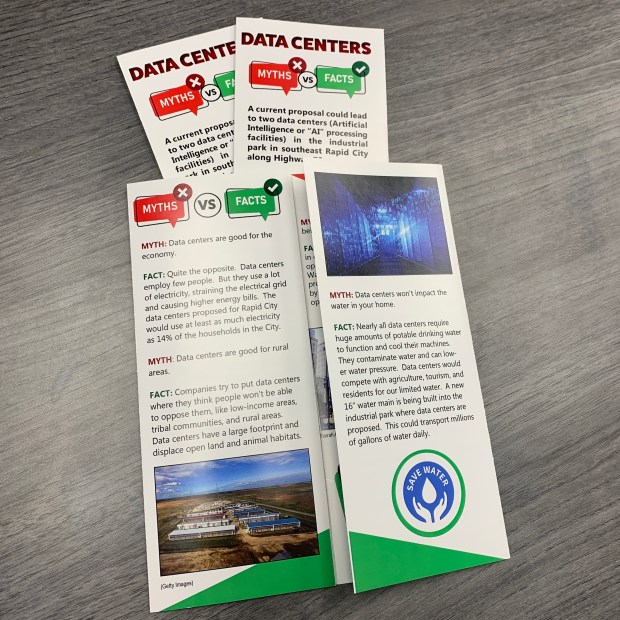
Below is a printable PDF of our 14″ x 8.5″ eight-panel, gate folded, brochure. We also have pre-printed and folded brochures ready for distribution. Want to help hand-out this brochure? Let us know HERE.
This video explains how data centers are utilizing the power grid and why electric bills are on the raise in areas with one of these centers.
 Black Hills Clean Water Alliance