
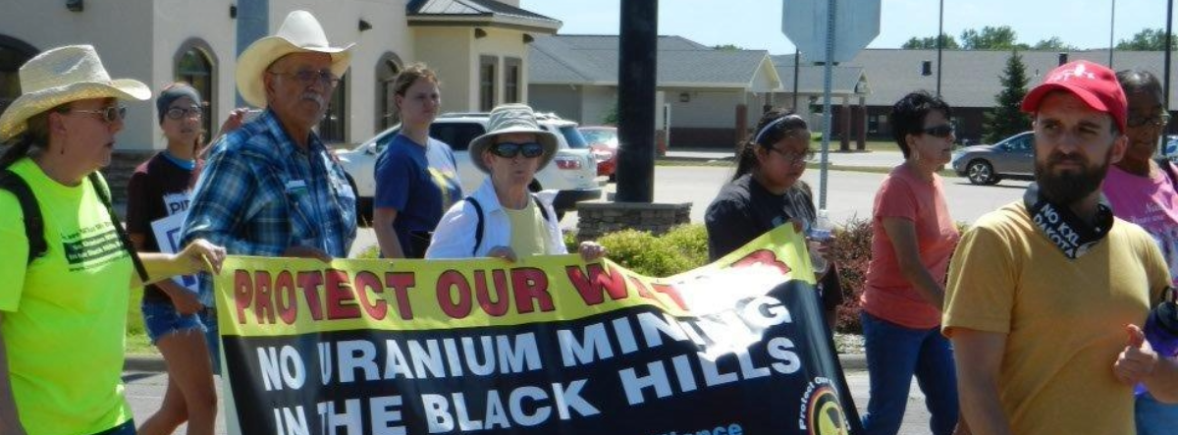
enCore Energy (through its subsidiary POWERTECH) does not have the critical permits or licenses needed to mine and/or start construction. It needs at least 10 permits/licenses before it can legally mine uranium in the Dewey-Burdock area located in the southwestern corner of the Black Hills.
See the recent September 2026 update below.
SEPTEMBER 2026 UPDATE ON DEWEY-BURDOCK URANIUM PROJECT
POWERTECH WILL AGAIN SEEK STATE PERMITS FOR DEWEY-BURDOCK URANIUM MINE
HOW CITIZENS, ORGANIZATIONS, & GOVERNMENTS CAN COMMENT and/or INTERVENE
Powertech Uranium is working on getting a number of permits from federal government agencies for their proposed Dewey-Burdock mine in Custer and Fall River Counties. They are also working to re-start the two state permits processes that were put on hold in 2013. Those permits are for the control of millions of gallons of public water and for building and operating the mine itself.
WHO OVERSEES PERMITTING FOR STATE WATER & MINE PERMITS?
Permits may be requested from two citizen boards: the Water Management Board (WMB) for water rights and the Board of Minerals & Environment (BME) for a mine permit. The members of these boards are appointed by the Governor, and their work is supported by the South Dakota Department of Agriculture and Natural Resources (DANR).
Staff at DANR work with companies to prepare their permit applications. Then a notice is published in the back of local newspaper(s) and on DANR’s website. This triggers a very brief window (10 or 20 days, depending on the type of permit) for individuals, organizations, and governments to make a public comment and/or to “intervene” in the permitting process. When someone intervenes to oppose granting a permit, the process is called a “contested case.”
WHAT IS AN INTERVENOR?
An intervenor is a person, organization, or government entity that has a stake in the outcome of the permitting process (for or against) and submits a petition to “intervene.” If successful in filing a petition in time and according to the rules, an intervenor becomes a party to the case. An intervenor can fully participate in all proceedings related to that permit, including bringing witnesses, submitting evidence, questioning other parties’ witnesses, and more.
An organization or government entity that is an intervenor must be represented by an attorney. Individuals can represent their own interests.
Being an individual intervenor in a permit process is a commitment. Most hearings take place in Pierre. Sometimes there is a remote option, but generally intervenors must cover their own expenses for gas and lodging. Physical copies of most documents must be sent to other parties through the U.S. Mail. Any witness(es) that an intervenor invites to testify may need their expenses covered.
All that said, an intervenor’s level of work is determined by the intervenor themselves. Intervenors can and do work together to rideshare, provide group meals, make motions that others can sign onto, etc. Communication networks are formed, and strategy can be discussed. Each intervenor still has the right to present their own evidence, call their own witnesses, and focus on the issues that matter most to them.
Sometimes organizations that have an active interest in a case are able to assist individual intervenors with costs, but it’s a good idea to take stock of your own abilities and resources up front.
INTERPETIVE SERVICES
If you are a first-language Lakota speaker or require interpretation services for any other language, recent passage of “Helen’s Law” requires the state to provide for interpretive services in all state administrative proceedings. If you or someone you know has a strong stake in a permit proceeding, do not let a language barrier prevent your/their participation!
PUBLIC COMMENT OR INTERVENTION?
Once the DANR puts out public notice on a permit process, it’s critical that people respond quickly. If you can’t be an intervenor, you can file a public comment – and encourage others to do the same.
A large volume of public comments either for or against a project is important! It lets the permitting board know that people are paying close attention to the project and the process. Public comments made during the 10-20 day public notice timeframe are part of the official record of a contested case, but they are not always carefully considered.
The official notice of a permit process will tell how to submit public comments. This information will also be available from Dakota Rural Action (see below) and from Black Hills Clean Water Alliance at bhcleanwateralliance.org. Watch for notices to come out!
WHAT’S THE CURRENT STATUS OF POWERTECH’S STATE PERMITS?
Powertech has withdrawn their old water permit applications, which involved over 100 intervenors. They plan to submit new water permit applications, potentially very soon, hoping that a new restrictive law will limit the number of intervenors.
If the water permit applications are finalized and public notice is published, people who have a stake in the outcome should be ready to make public comments and/or petition to intervene immediately. Those who opposed the old permits, but who may no longer qualify to intervene under the new restrictive law can petition to intervene anyhow, stating that their opposition is unchanged, and they should be “grandfathered in.”
On the mining permit side, Powertech has NOT (yet?) withdrawn their old application. They have not asked (yet!) to re-start the mine permitting process. If Powertech decides to move forward without a new application and notice process, new residents and new opponents can pressure the Board of Minerals to re-open the public comment and intervention process.
It’s also possible that Powertech is quietly lobbying for restrictions on intervention in mining permit cases (similar to those now in place for water permits) during the next legislative session. State legislators need to hear from YOU. Even if you don’t live in areas affected by mining, changes to the process for intervention on state permits would affect the ability of ALL South Dakotans to make their voices heard on ALL kinds of projects.
You can subscribe to the South Dakota DANR weekly public notices email list to keep track of permits being sought by providing your email address to DANRmail@state.sd.us. You can also find all projects currently under public notice by visiting https://danr.sd.gov/public/default.aspx Dakota Rural Action and allied organizations will also be watching for any change of status for both mining and water permits.
For more information, contact DRA Organizer Rebecca Terk: rebeccat@dakotarural.org

HOW TO INTERVENE IN A MINING OR WATER PERMIT CASE (September 2026)
AUGUST 2026 UPDATE ON DEWEY-BURDOCK URANIUM PROJECT
IMPORTANT NOTICE: The Nuclear Regulatory Commission’s Atomic Safety and Licensing Board Panel has scheduled oral argument on the New and Amended contentions in the Dewey-Burdock NRC license renewal case for August 13 at noon mountain.
For those members of the public who wish to listen to the oral argument, the Nuclear Regulatory Commission has set up a listen-only telephone line that can be accessed on Thursday, August 13, 2026, by dialing (301) 576-2978 and entering access code 493 835 159#. After successful entry of the access code, you will hear the following message: “You are not allowed to unmute. To raise your hand press *5.” Please note, though, this conference line will not be monitored and pressing *5 will not allow you to participate in the conference.
Please see attached Order with the public call in/listen only option.
JULY 2026 UPDATE ON DEWEY-BURDOCK URANIUM PROJECT
In the last couple weeks, the companies that want to mine radioactive and toxic uranium at the proposed Dewey-Burdock project in Custer and Fall River Counties have been busy. They have been actively working to convince the media and the public – and potential investors – that they have all their federal government permits for the project. Even media who usually provide factual journalism have repeated the company’s messages. That is – at best – a half-truth.
The companies’ and media’s statements are not just less than true. They are harming people. We’ve heard from a number of people who are dismayed at the supposed situation. It’s no wonder that they are upset at the possibility of the mining moving forward. Individuals, organizations, and communities have been fighting against this project for 20 years now due to its threats to cultural resources and to both water quality (think radioactivity and destruction of aquifers) and water quantity. The 2012 water applications for the proposed Dewey-Burdock project asked for water rights to over 9000 gallons of water per minute — well more than Rapid City uses. The company would get all this water for nothing – Free use and destruction of water that legally belongs to all the people in South Dakota.
A LITTLE HISTORY ABOUT A BIG PROCESS
This particular media blitz by the companies – Powertech Uranium and its parent company, enCore Energy — is important. Two State of South Dakota decision-making boards that were holding hearings on various permits for the project stopped their processes in 2013. They both said that they would not re-start the state permitting processes until the company had all of its federal permits for the Dewey-Burdock project.
Opposition to the proposed project has included a public vote that established that uranium mining is illegal in Fall River County. This is a clear statement of public opinion, as well as legally binding. There have also been meetings, appeals, lawsuits, rallies, forums, resolutions by tribal governments and the state’s doctors and its second-largest city, dozens of individuals intervening in hearings — and one would think that the companies would take the hint.
But they haven’t. Instead they are continuing to try to do permanent harm to the Black Hills and the water on which life here is based. And bending the truth to feed their greed.
WHERE ARE WE NOW WITH THE FEDERAL PROCESSES?
So here is the actual situation at this point in time. At least two of the federal government agencies that have a say in the project have tried to grant permits in situations in which there are active legal actions against their attempts to make decisions. Black Hills Clean Water Alliance is one of the plaintiffs in these lawsuits, along with the Oglala Sioux Tribe and NDN Collective.
The first situation involves the Nuclear Regulatory Commission (NRC), which made a “decision” to allow the renewal of Powertech’s license to handle radioactive materials in June 2026 – while the renewal process was under a legal challenge. New or amended statements of issues can still be filed, and the legal issues will probably go to a hearing at some point.
The second situation involves the Environmental Protection Agency (EPA). The EPA’s attempts to permit the Dewey-Burdock project to use and contaminate water from two aquifers, pump the remaining wastes into a third aquifer, and forbid the use of an aquifer for drinking water in perpetuity have been appealed repeatedly. But in all the legal cycling, the issues under appeal have never been considered by a court. That changed recently, as the case is now before the federal Court of Appeals for the Eighth Circuit. There will be oral arguments in this case, probably in early 2027, with a decision six to nine months later.
Legal action around both of these agencies’ decisions has been going on for years, without solutions to major issues at the Dewey-Burdock site, including the failure to properly protect cultural and historical resources and water.
A third federal agency, the Bureau of Land Management, recently told the uranium companies that they could build infrastructure on a very small sliver of the 10,000+-acre project. There is the possibility that this will be appealed, as well.
Any company that was trying to be fully truthful would have made all this clear. But that was not done. Instead, it appears that the company is trying to push the state to take the action it wants and to fool the public, the media, its investors, and potential investors.
WHERE ARE WE AT WITH THE STATE PROCESSES?
In its rush to get its state permits – or to look like it is getting its state permits – and while the federal permits are in limbo, Powertech/enCore has tried to get the state permitting processes going again. They also tried to do this in 2021, without success.
The state Department of Agriculture and Natural Resources (DANR) has encouraged the companies to re-apply for their permits, rather than to pick up where things were in 2013. Since then, people who were parties to the hearings have passed away or moved away, and new people are interested in this issue. DANR leadership has changed, and the staff member who took the lead on these issues retired and was replaced. Membership on the state decision-making boards has changed. Powertech has had a couple new ownership arrangements. So there is an obvious learning curve for state employees and Board members before they can consider any new permit application.
In response, the company has submitted new water rights applications. There is apparently not a new mining permit application at this time. Powertech has not yet officially withdrawn its old permit applications.
HERE’S WHAT YOU CAN DO NOW
The submission of new applications re-starts the state permitting processes from the beginning, so individuals and groups will be able to sign up as intervenors in those processes. Assuming someone does that, there will be a public hearing. So if the water rights applications are okayed for continued processing, people who want to protect water have a clear opportunity to do that by becoming intervenors in the process.
In the meantime, it’s important to learn about this proposed project and to share what we learn with our friends and families. The consideration of the Dewey-Burdock project has been going on for awhile, and the resulting information is voluminous, but most of it is summarized on our website at https://bhcleanwateralliance.org/dewey-burdock-project or on the state’s website at https://danr.sd.gov/public/ContestedCase.aspx
You can also find other important SD-DANR links on our website HERE.
This situation is a reminder to all of us to check our facts. It’s difficult in this world of semi-fact, conspiracies, and rushed responses to remember to stop – ask – and check it out for yourself. When we don’t do those things, there can be real damage – to ourselves, as well as to others and to our united efforts to protect the Black Hills. Saving the Black Hills and their waters from the current onslaught of mining proposals is important, and we encourage everyone to act with courage, respect, and mindfulness of what is at stake.
JUNE 2026 UPDATE ON DEWEY-BURDOCK URANIUM PROJECT
The comment period for the portion of the proposed Dewey-Burdock uranium mine that would be on land that is controlled by the Bureau of Land Management (BLM) closed on May 14th. The BLM received just over 700 comments! This proposed project covers approximately 10,580 acres in Custer and Fall River Counties and intends to use in situ leach mining.
Thank you to everyone who commented and shared information!
enCore Energy, through its subsidiary Powertech, is planning the Dewey-Burdock mine. The company initially planned to begin mining in 2009. The project has faced strong resistance from the Oglala Sioux Tribe, our organization, a number of other organizations, and the public. This included residents of Fall River County, who voted to prevent new uranium mining in a citizen initiative in 2022. To date, mining has not started.
DEWEY-BURDOCK URANIUM PROJECT
PUBLIC COMMENT ENDED ON MAY 14, 2026
There is a new opportunity for you to do something to oppose plans to mine radioactive uranium in Custer and Fall River Counties. Public comments on part of the proposed Dewey-Burdock mine are due to the U.S. Bureau of Land Management (BLM) by May 14, 2026.
The Dewey-Burdock mine is planned by enCore Energy through its subsidiary, Powertech. Powertech intended to start mining in 2009, but determined public and tribal government resistance has meant that it hasn’t started yet.
The Dewey-Burdock project would be about 10,580 acres and would mine using the in situ leach process. The Draft Environmental Assessment (EA) for this project focuses only on the surface area that is controlled by the BLM, but the agency also controls 41% of the subsurface rights in the project area. Your Comment is Needed Today…Read More
Go to the Federal Level Comment Notices for more information and how to submit your comment.

