
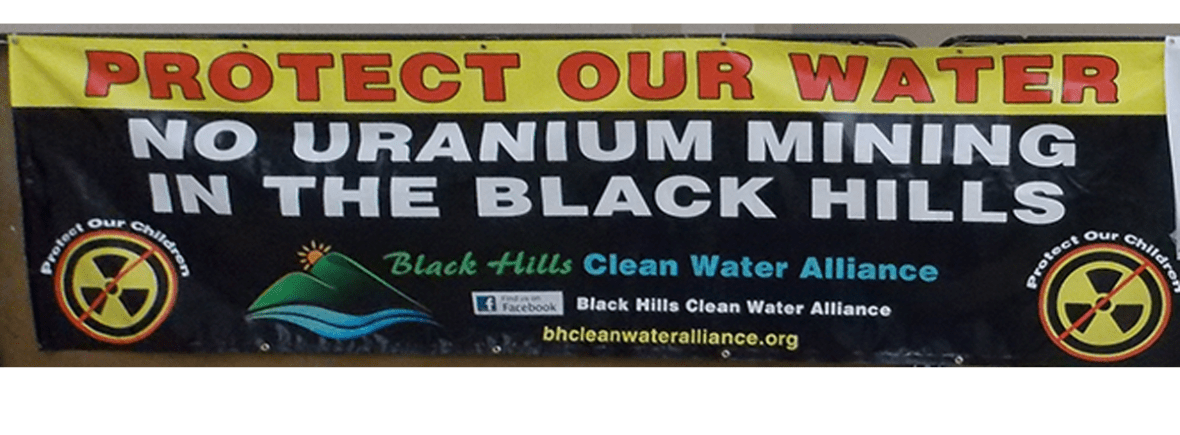
IT’S ALL ABOUT OUR WATER. THIS IS NOT JUST A LOCAL ISSUE. WATER IS LIFE!
What is Uranium?
Uranium is a naturally-occurring element. It generally poses no danger when it is left in the ground. However, when it is brought to the surface and concentrated, it emits dangerous levels of radiation. Once uranium begins to emit radiation, it breaks down into other heavy metals in a process that cannot be stopped and lasts millions of years.
Why the rush to mine Uranium?
There is a lot of money to be made. Companies plan several projects in the Black Hills in hopes of a “nuclear renaissance” that would bring their companies billions of dollars and leave us with the mess. Are their profits worth your health? Our water?
WHAT IS IT WORTH?

In March 2024, the global average price per pound of lightly processed uranium (aka “Yellow Cake”) stood at roughly $71.81 U.S. dollars. Uranium prices peaked in June 2007, reaching 136.22 U.S. dollars per pound. The average annual price of uranium in 2023 was 48.99 U.S. dollars per pound.
No matter what the price is per pound, water is far more valuable than “Yellow Cake.”
IT’S NOT WORTH SACRIFICING OUR WATER!
Companies plan a number of projects in the Black Hills in hopes of a “nuclear renaissance” that would bring their companies billions of dollars and leave us with the mess. Are their profits worth your health? Our water?
WHY NUCLEAR ENERGY ISN’T CLEAN – A VIEW FROM THE “FRONT END” OF THE NUCLEAR CHAIN
While the nuclear industry often promotes nuclear energy as a “clean” energy source, it poses significant environmental and health risks at every stage of the nuclear process – from exploration for uranium to processing uranium into nuclear fuel, to finding a destination for high-level nuclear waste. Nuclear power is the most expensive and hazardous method of generating electricity by boiling water.
At the “front end” of the nuclear process, there are significant human health impacts from uranium exposure. Recent research on this topic has been conducted in South Dakota. Uranium is both radioactive and toxic. It can damage a number of body systems, including the lungs, bones, kidneys, and heart. Exposure also causes cancer, miscarriages, and birth defects.
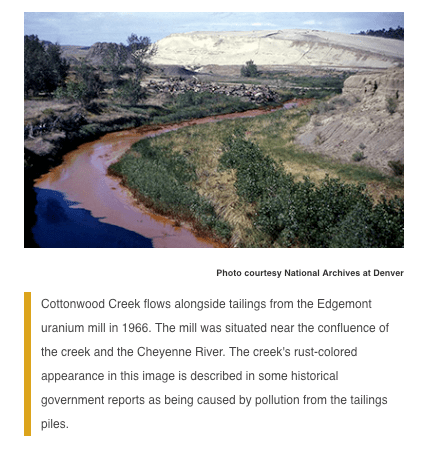
Water tests in the Cheyenne and Missouri Rivers and on the Pine Ridge Reservation show significant uranium contamination, with levels above the Environmental Protection Agency’s maximum contaminant level.
Uranium mining, milling, and transportation can also lead to significant environmental problems due to the radioactive and toxic nature of the ore and the associated processing methods. This is true for open pit, underground, and “in situ” mining. Hazards include radon emissions, radioactive wastes, water contamination, and harm to ecosystems.
Mining activities, including exploration, can also spread radioactive materials in the soil, potentially affecting plant life and the food chain. Waste rock and tailings from uranium mining pose long-term risks, as they can be sources of radioactive dust and can leach contaminants into the environment.
The high-level waste generated in nuclear reactors is extremely radioactive and remains dangerous for hundreds of thousands of years. This “spent fuel” requires secure and long-term storage, posing challenges for current and future generations. Currently, there is no safe long-term storage facility for high-level radioactive waste, and these wastes are stored temporarily at reactor sites.
There is no such thing as “clean” nuclear energy. At every stage of the nuclear process, the risks to human health and the environment – including from catastrophic reactor accidents — make it the most dangerous and dirty way to boil water to generate electricity.
HOW URANIUM MINING WILL AFFECT OUR WATER.
Uranium mining would use huge amounts of our precious water. It would pollute our water and expose human, livestock, wildlife and agriculture to radiation and heavy metal poisoning through air, water and food. Wind, flooding, wildfires, or tornadoes could spread radioactive materials throughout the area.
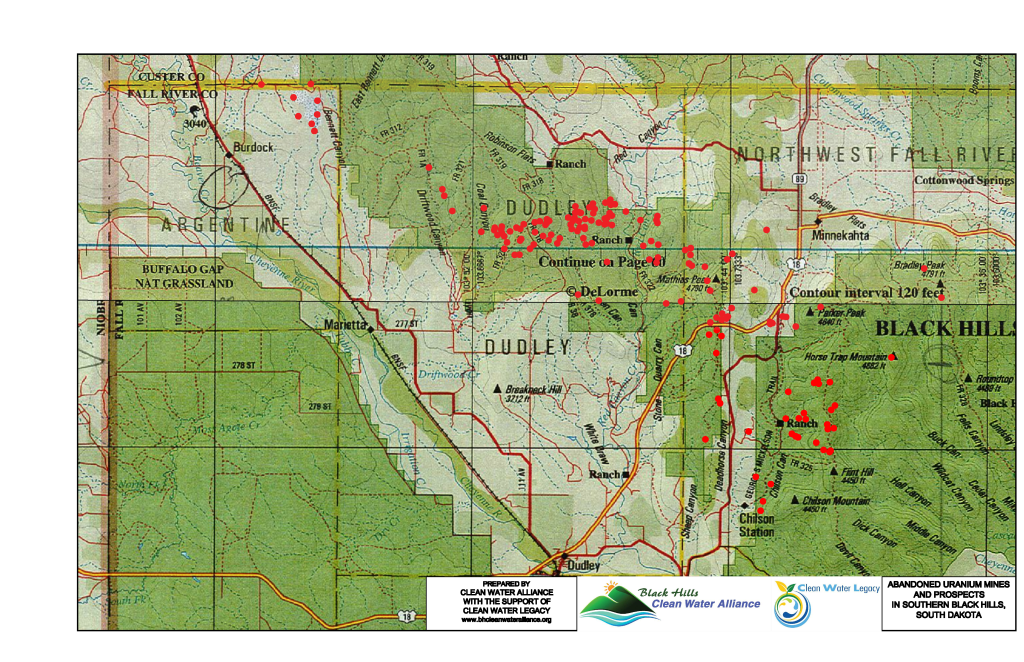
According to study by the SD School of Mines and Technology, old uranium mines in western South Dakota are already contaminating the sediment in the Cheyenne River. Other studies are limited but indicate water contamination. There are almost 200 old sites in the Black Hills, and the vast majority have never been cleaned up. Any new Uranium exploration or mining must be prohibited in the Black Hills (period), especially when the messes from past uranium mining have not even been cleaned up.
IT’S ALL ABOUT OUR WATER. THIS IS NOT JUST A LOCAL ISSUE. WATER IS LIFE!
Know the Hazards of Uranium

THE ENVIRONMENTAL AND HEALTH RISKS ARE HIGH — RADIATION CANNOT BE SEEN, SMELLED, FELT OR TASTED. DAMAGE FROM RADIATION IS AT THE CELLULAR LEVEL, WITH A HIGHER RISK TO CHILDREN AND SENIORS.
SPILLS, LEAKS, AND IMPACTS ON PEOPLE…
Spills, leaks, mechanical failures, and transportation accidents are common with uranium mining.
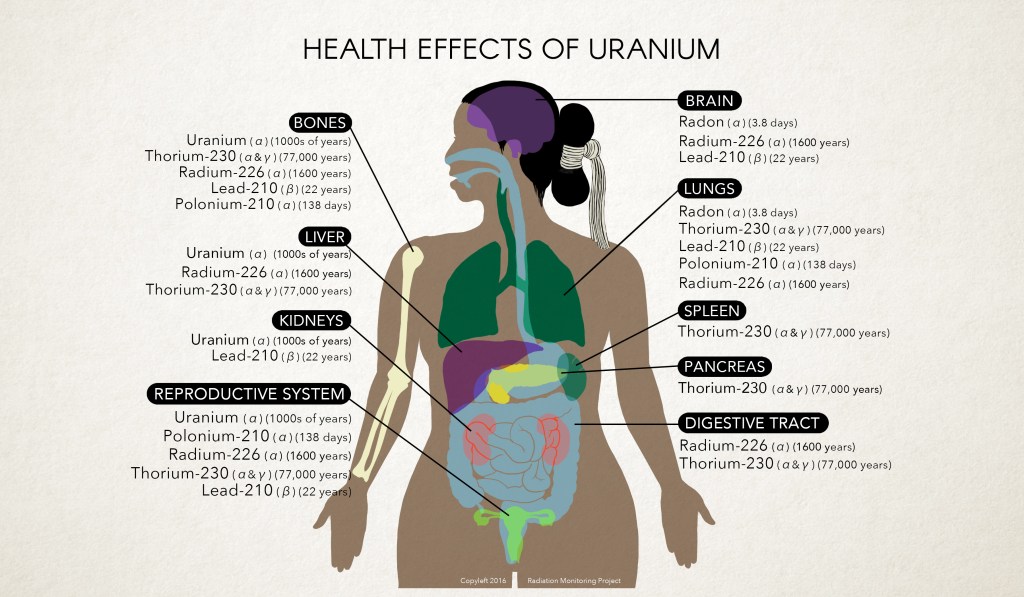
Ingesting uranium leads to kidney damage, and bone, liver, and blood cancer. Inhalation of radon gas causes lung cancer.
“The primary radiation health effect of concern is an increased probability of the exposed individual developing cancer during their lifetime. Cancer cases induced by radiation are generally indistinguishable from other naturally occurring cancers and occur years after the exposure takes place.” – Argonne National Laboratory, Dept. of Energy
The following two graphics are courtesy of Diné No Nukes‘ Radiation Monitoring Project.

WHAT ARE THE ECONOMIC HAZARDS?
We’ve already experienced uranium mining and milling in our region. Towns that welcomed uranium mining as “economic development” are now near-ghost towns or toxic sites. The uranium industry took their profits and left – leaving radioactive wastes, unreclaimed mines, and thousands of open drill holes.
The uranium industry would temporarily (ONE YEAR) add less than 2% more jobs in the southern Hills and would take away from the area’s main industries – agriculture and recreation. We need more clean long-term jobs, not short-term jobs that will permanently harm people, land, and water.
“Although these ‘in-situ’ leach mining techniques are considered more environmentally benign than traditional mining and milling practices they still tend to contaminate the groundwater.” – U.S. Nuclear Regulatory Commission, 2007
Know the History
Thousands of old uranium operations have been left unreclaimed in the upper Missouri River basin, including almost 200 in the Black Hills. Modern uranium companies employ people who were involved in past uranium operations. Why should we trust them to clean up future operations?
MINING HAS AN UGLY PAST
Mining is, by nature, a boom-and-bust economic activity. Short-term profits for companies are followed by long-term pollution and unemployment in mining areas.
Current, modern, operating in situ leach mines have spilled and leaked hundreds of thousands of gallons of contaminated water, both above ground and underground. These leaks have entered both above-ground and underground water bodies.
Regulators have been slow to respond. In Wyoming, state regulators didn’t issue a Notice of Violation to Power Resources, Inc. (now Cameco Resources), until they had two three-ring binders full of spill reports.
STATE PERMITTING BACKGROUND
In South Dakota in 2008, changes were made to Water Management Board Regulations to remove the requirement that before an in-situ uranium mining company could get a mining permit from the State, it had to prove by demonstration that it could restore the aquifer it wants to mine to its baseline (pre-mining) levels of radioactive heavy metals, arsenic, dissolving agents, etc. If it could not, and technology still can’t make it so, then a mining permit application would have to be denied by our State DANR.
In 2011, the uranium industry suggested a bill that suspended the new regulations, which the State Legislature passed. So currently South Dakota has no regulation of in situ leach uranium mining operations. There are laws that require a mining permit, but that’s about it.
Know the Threats

There are now four uranium projects in the southwestern Black Hills. The first one listed here has been challenged and stagnant since 2009. The other two want to do exploration drilling.
Dewey-Burdock project
The Dewey-Burdock project, is a large project (over 12,000 acres) that is currently owned by enCore Energy of Texas, but is still known locally by its original owner’s name, Powertech.
Powertech planned to start this ISL mining project in 2009, but they need at least 10 permits before they can begin. They have been on hold at the state level since 2013, and was also stopped for several years by the lawsuit by the Oglala Sioux Tribe. More recently, citizens of Fall River County have passed a county initiative to block uranium mining.
Click HERE for more information and updates.
Chord project
The Chord project, which is composed of 3,677 acres east of the Dewey-Burdock project in the Craven Canyon area. This area had a lot of exploration drilling in the 1970s and is a world-class cultural resources site. Union Carbide Corp. started mining in Craven Canyon without getting a state mining permit in 1979 and was stopped by legal action by the Black Hills Alliance (BHA), a regional nonprofit group. This mining was stopped because a local citizen noticed the movement of large equipment into the area and called the BHA.
This misnamed company called “Clean Nuclear Energy Corp.” (CNEC or C-NEC) was obviously trying to score public relations points by including “Clean” in their name. The nuclear industry – including uranium mining – is a very dirty enterprise.
This NEW proposed uranium drilling is east of Edgemont in the southern Black Hills. This drilling project would be on a part of the Chord Project that is on state-controlled land. State-controlled land is not eligible for a mineral withdrawal. The current proposal would involve 50 drill pads – likely including multiple drill holes per pad.
This project threatens culturally and archeologically important area so much so that in 2015 the US Forest Service stated that the importance of the area “cannot be overstated.” This includes ancient petroglyphs and pictographs, as well as other sites. The Forest Service concluded that any adverse effect on this area “is rightly viewed as an affront to plains Native American culture and Indigenous human rights.”
The newly proposed drilling area would be within sight and sound of those praying or studying at this unique site.
Click HERE for more information and updates.
October Jinx project
The proposed October Jinx Project is part of the Chord Project. The Chord Project is composed of 3,677 acres east of the Dewey-Burdock project in the Craven Canyon area in the southern Black Hills. This area had exploration drilling in the 1970s and is a world-class cultural resources site.
Click HERE for more information and updates.
Wolf Canyon project
The Wolf Canyon project is also a Basin Uranium Project and is composed of 1600 acres of claims. It is about ten miles east of Edgemont and east of Highway 18.
Click HERE for more information and updates.
What is “ISL” Mining?
In situ leach mining (ISL) is a method of uranium mining where hundreds of wells are drilled in a “grid pattern” over an ore body that is located in a groundwater aquifer. Water mixed with sodium bicarbonate concentrate is pumped down into the aquifer, across the uranium ore bed, and them up and out other wells. The mining solution is injected into the aquifer under pressure in order to leach the uranium out of the ground. The leach solution strips the uranium out of the aquifer. Along with radioactive uranium, arsenic, selenium, radium and lead are also extracted.

In situ leach uranium mining must be done directly in a water-bearing aquifer. Drinking water comes from water-bearing aquifers.
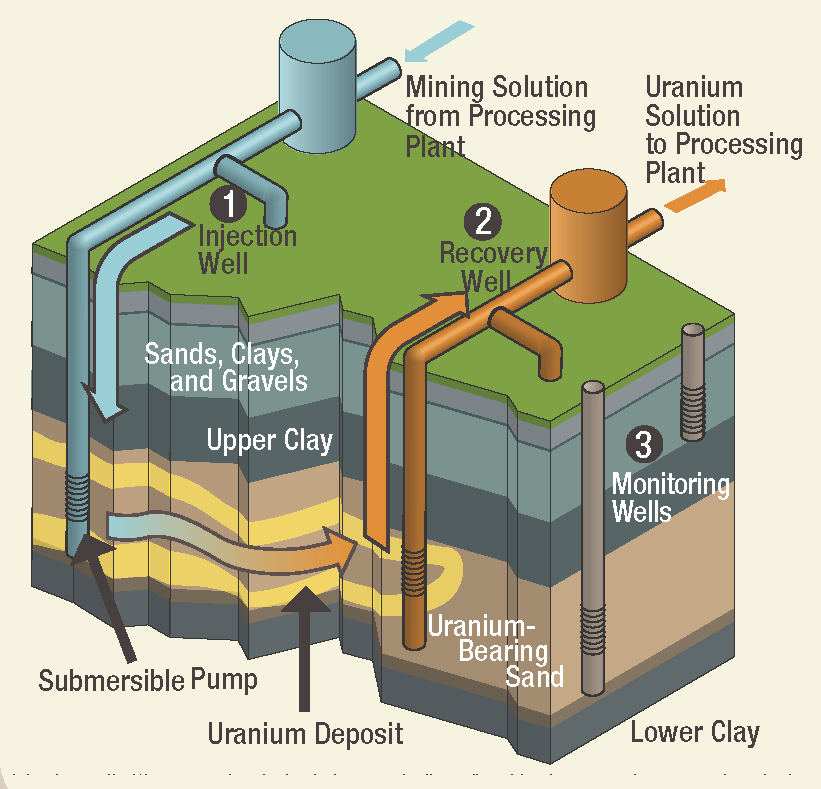
In situ recovery process. Image: Nuclear Regulatory Commission
Water at an in situ leach uranium mine has never been returned to its original condition. Pollutants that have been left in the water at in situ leach uranium mines after “restoration” include toxic heavy metals and radioactive materials.
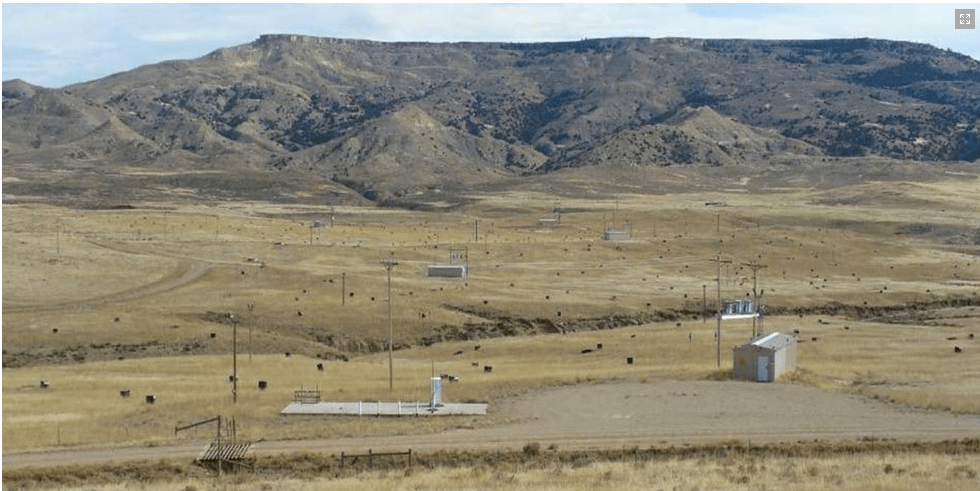
In Situ Leach Mining Operation
Christensen Ranch, Wyo.
There are hundreds, if not a thousand, of ISL Wells.
A Rapid City Journal’s Special Report:
For an in-depth history on uranium mining in the Black Hills region check out: Radioactive Legacy – the Rapid City Journal’s Uranium series shows the importance of oversight.

Will the town called Edgemont fare better this time?
Four decades after its first uranium mining boom ended, the Edgemont area remains scarred by unreclaimed mines, buried radioactive waste and health concerns. The story of that first boom has gone largely untold and unreckoned with, even as regulators consider approving a new kind of mining in the same place.
Will the town fare better this time? Perhaps, if the lessons of the past are uncovered and heeded. Here, in five parts, is the untold story of Edgemont’s radioactive legacy. – See more at: http://rapidcityjournal.com/app/pages/uranium/
 Black Hills Clean Water Alliance