
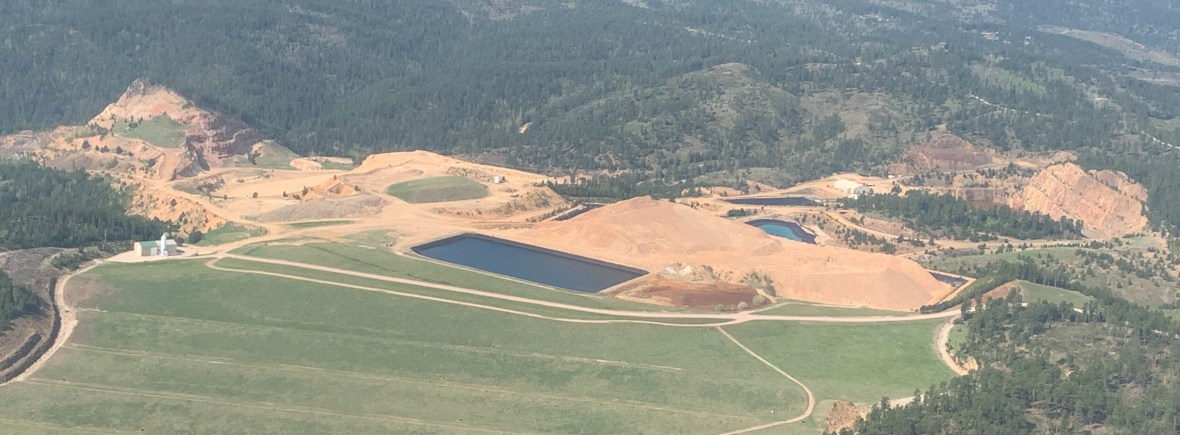
Agnico Eagle still has some active mining claims in the northern Black Hills, as of January 3, 2026. Most — if not all — of these claims are in Lawrence County.
Agnico Eagle terminated the Agreement for gold exploration at Gilt Edge Mine Superfund Site
The Agreement became effective on July 17, 2023, and allowed Agnico Eagle to evaluate the Site for potential reuse opportunities, while paying over $2 million in water treatment costs associated with the Site. Ultimately, Agnico Eagle determined that re-mining the Site is not economically viable; it will not pursue further investigation. As required by the Agreement, Agnico Eagle submitted a Termination Plan on July 17, 2024. EPA and the State of South Dakota approved the plan on July 22, 2024. Once the requirements of the Termination Plan are met, Agnico Eagle will submit a Termination Completion Report for EPA and State approval. The EPA and the State of South Dakota will then resume the CERCLA process at the Site, which includes site-wide consolidation and containment of mine wastes and continued treatment of contaminated water. EPA has posted the response to public comments (pdf) (6 pp, 7.11MB, About PDF) on the Gilt Edge Mine Superfund Site Agreement (pdf) (43pp, 1.5MB) between EPA, the State of South Dakota, the Department of Justice, and Agnico Eagle Mines, Ltd. EPA also issued Notice of Effective Date (pdf) (1pp, 707KB) which finalizes this agreement.
EPA’S official announcement here: https://cumulis.epa.gov/supercpad/SiteProfiles/index.cfm?fuseaction=second.Stayup&id=0801668#Announce
Gilt Edge – an Abandoned Mine – Background
The 360-acre Gilt Edge Mine site is located about 6.5 miles east of Lead, South Dakota. The primary mine disturbance area encompasses a former open pit and a cyanide heap-leach gold mine, as well as prior mine exploration activities from various companies. In the late 1990s, the most recent mine operator, Brohm Mining Company (BMC), abandoned the site and their on-going water treatment responsibilities to address acidic heavy-metal-laden water (acid rock drainage) that is constantly generated from the exposed highwalls of the three open mine pits and from the millions of cubic yards of acid-generating spent ore and waste rock.
Mining and mineral processing at the site began in 1876 when the Gilt Edge and Dakota Maid mining claims were located. Sporadic mining by numerous operators took place at the site until the early 1920s. Early gold miners developed extensive underground workings that wind through the central portion of the site and also engaged in some surface mining as well. From 1935 to 1941, the mines at the site were in steady production and the underground workings were expanded. Beginning in 1976, an extensive mine development program investigated potential production of gold or other minerals. In 1986, BMC commenced development of a large-scale open pit, cyanide heap leach gold mine operation. In July 1999 BMC abandoned the site and their on-going water treatment responsibilities to address acidic heavy-metal-laden water (acid rock drainage) that is constantly generated from the exposed highwalls of the three open mine pits and from the millions of cubic yards of acid-generating spent ore and waste rock remaining at the site.
Historical operations at the site contaminated surface water and groundwater with acidic heavy-metal-laden water. Investigation and cleanup activities at the site are ongoing. Interim remedies are currently in place for two of the site’s three areas. And remedial action construction is in progress for the third area.
PROSPECTIVE LESSEE AGREEMENT, AGNICO EAGLE MINES LIMITED, AGNICO EAGLE (USA) LIMITED, LAWRENCE COUNTY, SOUTH DAKOTA
Notice is hereby given by the U.S. Environmental Protection Agency (EPA), Region 8, of a prospective lessee agreement between the United States, the State of South Dakota, Agnico Eagle Mines Limited, and Agnico Eagle (USA) Limited (collectively “Agnico”), at the Gilt Edge Mine Superfund Site in Lawrence County, South Dakota (Agreement). The agreement provides that Agnico will perform a reuse assessment, including surface and subsurface sampling, and pay at least $2.5 million annually to cover the cost of water treatment and site operations at the Gilt Edge Mine Site during the pendency of the Agreement. In exchange, the United States and the State of South Dakota covenant not to sue Agnico for Existing Contamination, work (including subsurface and surface sampling) conducted by Agnico, and certain payments as defined in the agreement.
Comment Period Ended on April 21, 2023.
Johnson’s Gilt Edge Mine Conveyance Act Passes the House
September 29, 2022 – Press Release
Washington, D.C. – Today, U.S. Representative Dusty Johnson’s (R-S.D.) legislation to transfer to the State of South Dakota a portion of the Gilt Edge Mine superfund site owned by the U.S. Forest Service. The bill passed the House 296-127.
“For years this site has been owned and managed by a patchwork quilt of state and federal governments. My bill will make it easier for the State and EPA to remediate the site by getting the Forest Service out of the middle,” said Johnson. “This land is no longer a forest or natural habitat, nor can it be used for recreation. Allowing South Dakota to purchase and own this land is an important step in finishing the cleanup.”
You can watch Johnson’s floor remarks here.
- Agnico Eagle – Gilt Edge Superfund Site
- Dakota Gold & Dakota Territory Resource Corp.
- F3 Gold – Projects are the Jenny Gulch (POO) and the Newark (POO)
- Mammoth Minerals
- Solitario Resources Corp. Projects are Golden Crest (POO) and the Ponderosa (POO)
- Wharf Resources (USA) Gold Mine
 Black Hills Clean Water Alliance