
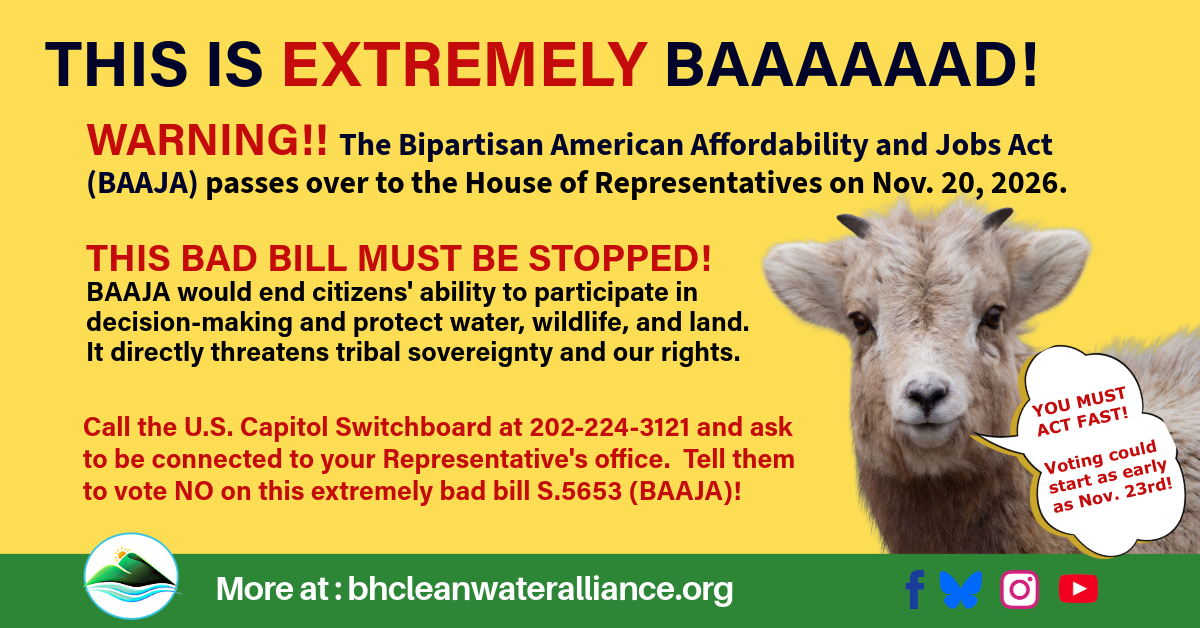
BAAJA Update 11/20/26 – Despite a huge public outcry, the deceivingly-named Bipartisan American Affordability and Jobs Act (BAAJA) has passed the US Senate and now passes over to the US House. That vote can be anytime starting this coming Monday. We must act fast! If this legislation becomes law, it will have major impacts on basic laws that people rely on for protection from negative impacts to our lives and threats to our communities.
Here in the Black Hills, it could prevent citizens, tribal governments, local governments, and nonprofit organizations from protecting water, land, wildlife, and our rights from mining. It would put decision-making power into the hands of the companies that want to mine here and take it away from us.
This may sound extreme, but that’s because this legislation is extreme. If BAAJA passes the US House of Representatives and is signed by the President, it would remove or weaken many of the laws that can currently can protect us from the destructive mining projects that companies have proposed – or will propose — in the Black Hills.
This means we would need to rely more on state law, which is extremely weak. For example, state law allows exploration drilling to go forward without public input, a hearing, or consideration of environmental or cultural resource issues.
If a decision was made by — say — the US Forest Service that violated the National Environmental Policy Act (NEPA), there would be no way to for a court to take action to remedy the problem. For a specific example, the legal work that was one of the tools that helped to derail the graphite drilling project at Pe’ Sla in May would not have been possible.
Tribal consultation and cultural resources protection under Section 106 of the National Historic Preservation Act would not be required – they would be discretionary. And that means they probably would be non-existent.
NEPA would still exist, but would not protect our communities, water, land, and health as it has since 1970. If there was an issue related to some other federal law, such as the Clean Water Act or the Endangered Species Act, those would still be in force.
BAAJA, also known as S. 5653, needs to be stopped. This means you need to take action today! The bill could come up for consideration in the US House of Representatives at any time. Call your Representative today and leave a message saying you oppose S. 5653.
Your message does not have to be long or detailed. In South Dakota, this means call Rep. Dusty Johnson TODAY at:
- 605-646-6454 (Rapid City)
- 605-275-2868 (Sioux Falls)
- 202-225-2801 (Washington, DC)
You can also call the U.S. Capitol Switchboard at 202-224-3121 and ask to be connected to your Representative’s office. Tell them to vote NO on BAAJA (S. 5653)!
Follow us on Social Media

