
GOOD NEWS!
HUGE DROP IN THE NUMBER OF ACTIVE MINING CLAIMS IN THE BLACK HILLS!
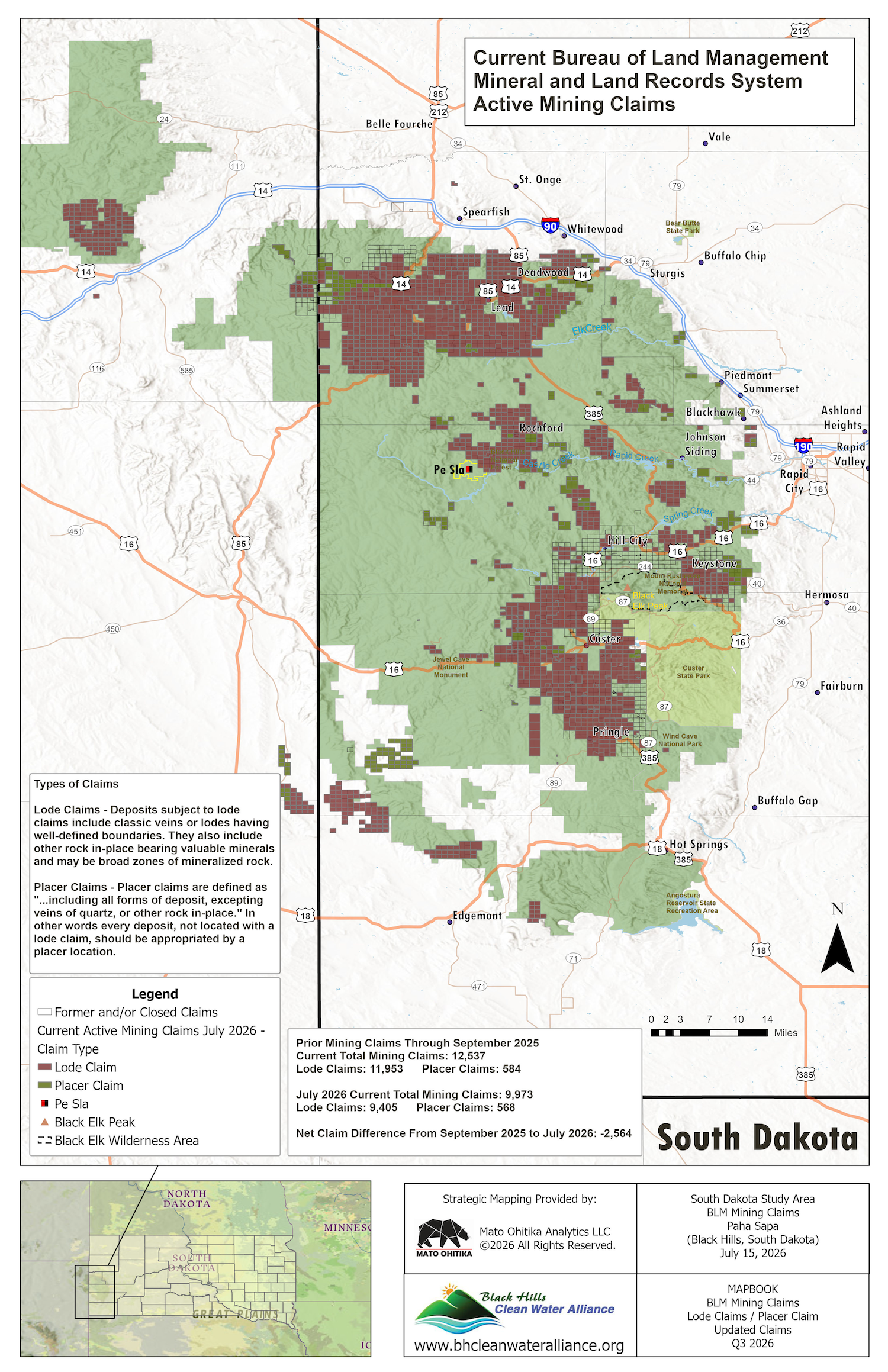
Something important is changing in the Black Hills – something that we’re very happy to report. Between September 2025 and July 2026, the number of active mining claims in the Black Hills dropped by 20%!
There are now 9,973 active mining claims, or about 206,042 acres of the Black Hills are covered by claims. That’s not a small number – about 17% of the entire Black Hills National Forest – but it’s the first time since August 2022 that the number of claims has dropped below 10,000. Most claims are about 20.66 acres. Anyone can stake a claim on most federal public lands under the 1872 Mining Law.
The lowest number of active mining claims in the Black Hills in the last 10 years was in 2017, when only .002% of the Hills were under claims. The highest number of claims in recent years was in November 2023, when 24% of the Black Hills were under active claims.
We looked into what might be causing the recent drop in the number of claims, and it looks like several things are at work. We took a sample of the claims that were no longer in existence, looked at who had held them, and looked at what was happening with the minerals and companies involved.
Some claims seem to have ended because the US Bureau of Land Management, which is the agency that administers the claims process, took long-abandoned claims off their records. We found several claims that had not existed since the early 1990s, for example. The owners of most of the ones that were in our sample were redacted, so we couldn’t tell any more about what was going on.
Three companies with an interest in lithium mining in the Black Hills have either left the area completely or seriously scaled back their activities here. Some of this is likely to be changes in corporate focus, partly due to buyouts. Another reason for the changes in corporate focus is that the price of lithium has fallen by 75% in the last 4 years. This is a result of a global glut of the mineral and of efforts to replace the unstable lithium (prone to starting fires) with battery recycling and sodium-ion batteries.
In other words, excitement about lithium mining has dropped not only in the Black Hills, but also on world markets. From what we can tell, the companies that appear to have lost interest in mining lithium here are:
- New Energy Metals, which had claims near Mount Rushmore, among other places. It was acquired by Patriot Resources, an Australian company, and then dissolved in June 2026. At this time, neither company has any active claims in the Black Hills, and Patriot’s website does not list any projects in South Dakota.
- South Dakota Operations (SDO), whose projects included one on the south boundary of Hill City. SDO was acquired by Midwest Lithium, and then by Armada Metals. Armada is now focused on nickel and copper projects in Africa. Midwest had about 23,000 acres of claims in the Black Hills in 2023. Now, neither Midwest nor Armada has any active claims in the Black Hills, and neither is incorporated in South Dakota. SDO is still a registered corporation in South Dakota and still has some claims – about 120, or around 2,500 acres.
- Rapid Critical Metals, an Australian company, which sold its Black Hills project to IRIS Metals (more below) in September 2025. They are not registered with the state and have no active claims in the Black Hills.
A fourth company has dropped some claims, but remains active in the Black Hills. As with other mining operations, this involves a convoluted corporate situation.
White Rock LLC is the company that has dropped some claims recently. It was acquired by IRIS Metals, an Australian company, in 2022. IRIS has been in the lithium business here and acquired some claims from Rapid Critical Metals, as noted above, and some from SDO.
Then in August 2026, IRIS became Palisades Metals. Palisades is an Australian company. Neither IRIS nor Palisades has any active mining claims in the Black Hills. However, IRIS and White Rock, which still has around 500 active claims (about 10,300 acres), are both registered corporations in South Dakota.
To top it off, some of White Rock’s dropped claims list an address in Rapid City that has been associated with Cody Schad, a mining entrepreneur who has been affiliated with projects that have run into some problems with the state. Whether Schad has any involvement with Palisades is unknown, but he still has somewhere around 140 active claims in his own name in the Black Hills (about 2900 acres).
Our most recent map of active mining claims shows the changes between September 2025 and July 2026. Claims that have been closed are shown by black outlines around the former claim locations. This map is accurate down to the quarter-section, but does not show the exact location of claims within a quarter-section.
The areas with the largest drop in active mining claims include the Hill City – northern Mount Rushmore area, the north side of Custer, parts of the Wyoming—South Dakota border, and areas along the western border of Custer State Park and Wind Cave National Park. While quite a few of these appear to be lithium claims, there is probably a drop in claims for gold, uranium, and possibly rare earths.
A 20% drop in active mining claims in the Black Hills is a good thing, regardless of what caused it! In this case, it looks like many of the closed claims are related to lithium projects. In turn, the drop in claims is probably related to current market forces. But it doesn’t hurt that people have made it quite clear that we don’t want new lithium mining in the Black Hills! Mining companies look for the point of least resistance, and the Black Hills are not it.
Let’s keep the pressure up and continue to work hard to end the 9,973 remaining active mining claims!
Watch our Public Comment Opportunity notices to help protect Black Hills water. Click HERE.
Stay up-to-date by following us on our social media.

